Know the Latest When Coding Wound Care
Stay up to date on coding practices for autologous blood-derived products associated with chronic wound care.
Medicare coverage and coding for chronic wound therapies continue to evolve, and medical coders are increasingly asked to interpret how newer technologies cleared by the Food and Drug Administration (FDA) fit within existing HCPCS Level II code structures. Autologous blood-derived products, for example, once narrowly associated with platelet-rich plasma (PRP), now encompass a broader range of point-of-care wound treatments. Let's look at what brought on this shift and how it has affected coding these products.
The Procedure and FDA Classification
Modern point-of-care wound therapies (e.g., FastSkin® Patch) involve drawing a small sample of a patient's peripheral blood and processing it using an FDA-cleared device to produce an autologous blood-derived product such as an autologous whole blood clot that is applied directly to a wound.
The process generally includes:
Drawing a small volume of the patient’s blood
Preparing the autologous blood-derived product using a disposable cartridge or device
Allowing the material to clot or otherwise form a biologically active matrix
Applying the resulting product topically to the wound during the same encounter
The procedure is performed entirely at the point of care, typically in a physician’s office, outpatient hospital department, or wound clinic. No off-site laboratory processing is involved, and all preparation and application steps occur during the same visit. These therapies may be used for the management of chronic wounds such as diabetic foot ulcers, pressure ulcers, leg ulcers, and mechanically or surgically debrided wounds.
Recognition of Autologous Blood-Derived Therapies
Historically, the Centers for Medicare & Medicaid Services' (CMS') coding guidance for blood-derived wound treatments focused primarily on PRP. Early HCPCS Level II codes described procedures involving phlebotomy, centrifugation, and application of PRP to chronic wounds. As wound care technologies evolved, newer point-of-care systems (e.g., ActiGraft® RD2) began producing clinically relevant blood-derived products using methods other than centrifugation. Some of these systems generate autologous whole blood clots or similar biologic matrices that contain platelets, fibrin, plasma, and white blood cells and are applied directly to the wound.
These technologies raised questions about whether PRP-specific HCPCS Level II codes could appropriately describe procedures that did not isolate platelets through centrifugation. CMS ultimately addressed this issue through revisions to the HCPCS Level II code descriptors.
Expanded Descriptors and Their Impact
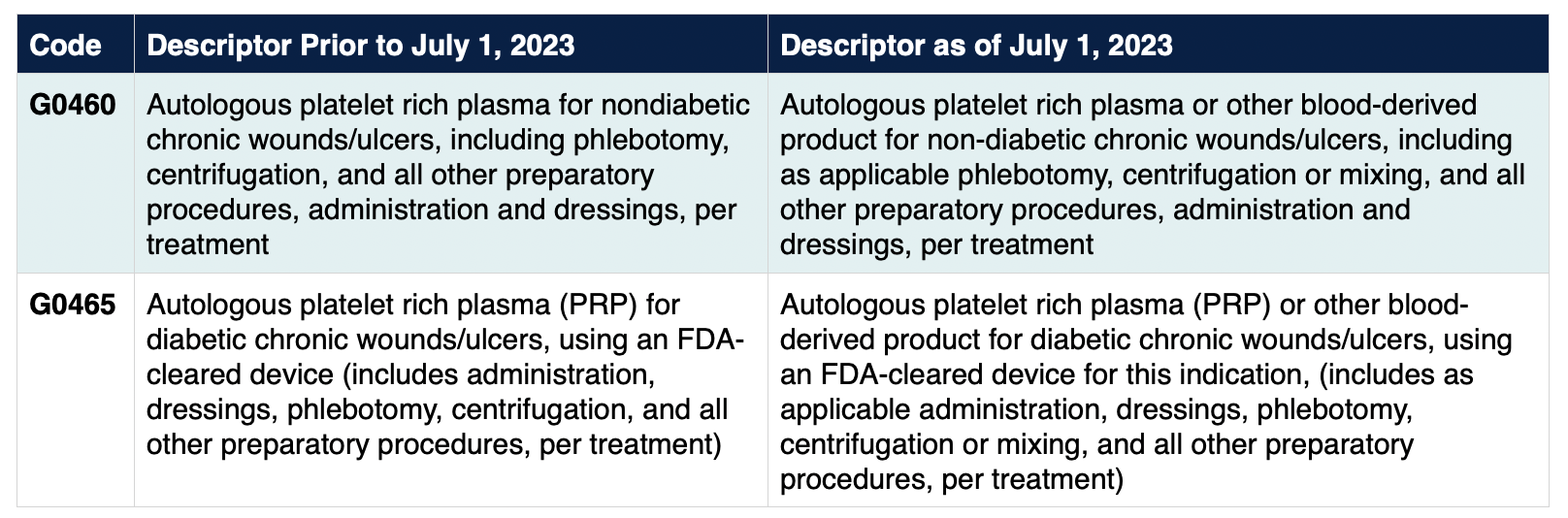
Effective July 1, 2023, CMS revised the descriptors for HCPCS Level II codes G0460 and G0465 to explicitly include “PRP or other blood-derived product” (see Table 1). This revision reflected CMS’ recognition that modern point-of-care technologies may produce autologous blood-derived products that do not meet the strict laboratory definition of PRP but provide similar wound care services.
The updated descriptors also clarified that preparation methods may include centrifugation or mixing or coagulation. This language broadened the coding framework to include point-of-care preparation methods used by many newer blood-derived wound therapies. The coding focus therefore shifted away from the specific laboratory composition of PRP and toward the clinical service being provided — preparation and topical application of an autologous blood-derived product for chronic wound management.
Table 1: Historical and Current Code Descriptors for G0460 and G0465
Code Selection
When a blood-derived wound therapy meets code requirements, the service may be reported using existing HCPCS Level II G codes.
G0465 – Diabetic Chronic Wounds
This code applies to autologous PRP or other blood-derived products used for diabetic chronic wounds. Key requirements include:
The patient has diabetes
The wound is chronic and non-healing
The product is prepared using an FDA-cleared device for the indication
All preparation and application steps occur during the encounter
G0465 is nationally covered under Medicare National Coverage Determination (NCD) 270.3 for qualifying diabetic chronic wounds. Coverage typically allows up to 20 treatments over a 20-week period, when medical necessity and documentation requirements are met. Autologous whole blood clot systems prepared at the point of care using FDA-cleared devices fall within the category of blood-derived products described in the code descriptor and the NCD.
G0460 – Non-Diabetic Chronic Wounds
This code applies to the same type of service when performed for chronic wounds in patients without diabetes. However, unlike G0465, G0460 does not have national Medicare coverage, and coverage decisions are determined by the local Medicare Administrative Contractor (MAC). Providers should verify payer-specific coverage policies before billing this service for non-diabetic wounds.
Bundling and Documentation Requirements
Both G0460 and G0465 are comprehensive procedure codes. The following services are bundled and should not be reported separately:
Blood draw (phlebotomy)
Preparation of the blood-derived product
Mixing, coagulation, or centrifugation steps
Application of the product to the wound
Associated dressings
To support appropriate billing, documentation should include:
Wound etiology and chronicity
Confirmation of diabetes status (when applicable)
Description of the point-of-care preparation process
Identification that an FDA-cleared device was used
Evidence of medical necessity
For claims submitted under G0465, documentation must also demonstrate compliance with NCD 270.3 requirements.
Stay Up to Date
CMS policy now recognizes that autologous wound therapies may include blood-derived products other than traditional PRP. The key considerations for coders are no longer specific product names but whether the procedure meets updated CMS requirements for autologous blood-derived product preparation and application. For those who code these therapies and products, it is essential to stay apprised of changes as wound care technologies continue to evolve.
Disclaimer: The coding guidance and regulatory requirements described in this article are provided for general informational purposes. Coding logic and reimbursement mechanics vary by payer and setting. Hospitals and manufacturers should consult with compliance, legal, and coding counsel prior to implementing changes.