Selective Enzymatic Debridement
New CPT® Category III codes change how providers report and bill for this service.
On July 1, 2025, four new CPT® Category III codes — 0973T, 0974T, 0975T, and 0976T — were added to the code set to identify selective enzymatic debridement for deep partial and full-thickness thermal burns. The addition of these codes changed the way providers can report and be paid for the service.
What Is Selective Enzymatic Debridement?
Removal of nonviable burned tissue is a critical step in the treatment of partial- and full-thickness burns. Selective enzymatic debridement is a type of wound care that uses proteolytic enzymes to selectively remove dead or damaged tissue from a burn wound without compromising viable tissue. The aim is to preserve healthy tissue and promote faster healing. Although it is a lengthy procedure, selective enzymatic debridement is a less invasive alternative to surgical excision.
The term “selective” is important because it differentiates the technique from other procedures that use enzymatic agents that cannot delineate between healthy tissue and eschar. The procedure involves applying a selective topical enzymatic agent to remove eschar (dead tissue). Following topical application, a dressing is placed over the treatment area. After four hours, the eschar is removed and the wound bed is cleaned to make an assessment, including burn depth, color implications, and bleeding patterns.
Selective Enzymatic Debridement Coding
Effective July 1, 2025, the following CPT® Category III codes may be used to report selective enzymatic debridement performed by a physician or other qualified healthcare professional in an ambulatory surgery center (ASC) or hospital outpatient department (HOPD).
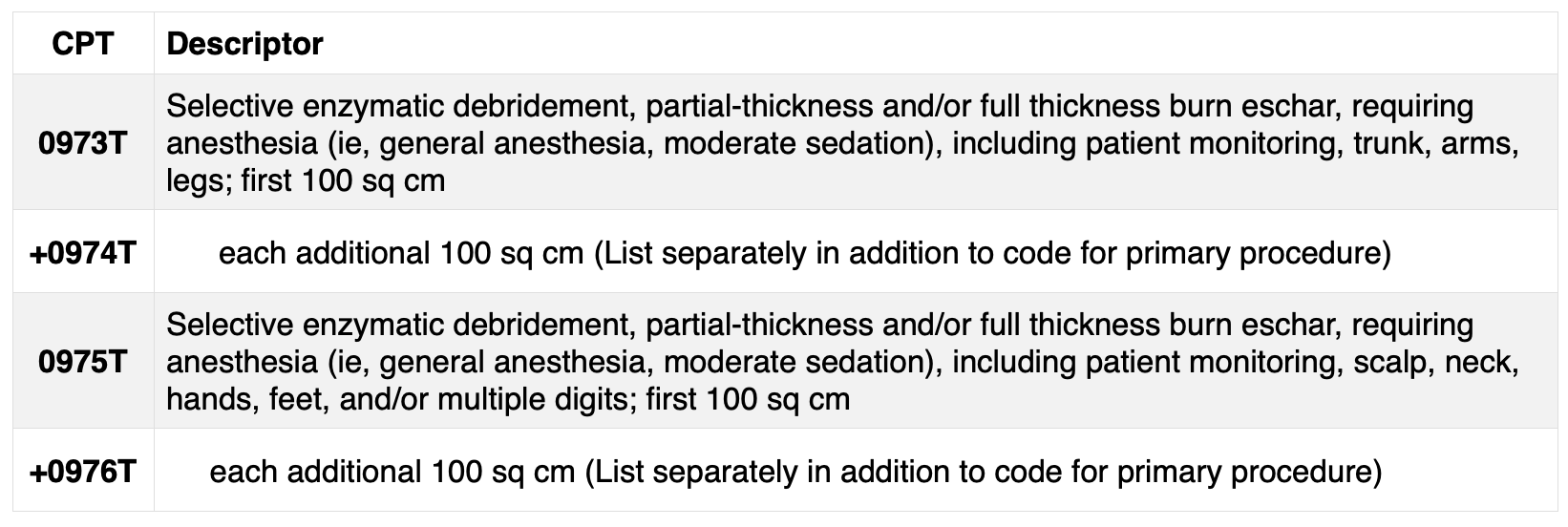
CPT® 2026 parentheticals for these codes instruct:
Report add-on code +0974T in conjunction with 0973T and add-on code +0976T in conjunction with 0975T.
Do not report these new selective enzymatic debridement codes in conjunction with debridement codes 11042, 11043, 11044, 11045, 11046, 11047, 97597, 97598 for the same wound during the same session.
For nonselective enzymatic debridement or enzymatic debridement that does not require anesthesia, report 97602 Removal of devitalized tissue from wound(s), non-selective debridement, without anesthesia (eg, wet-to-moist dressings, enzymatic, abrasion, larval therapy), including topical application(s), wound assessment, and instruction(s) for ongoing care, per session.
The American Medical Association states in CPT® Assistant (Nov. 25, Vol. 35, Issue 11), “Before the establishment of the new codes, these procedures were often reported with an unlisted code (eg, 17999).” With the creation of the new Category III codes, unlisted codes may no longer be used to report selective enzymatic debridement. Per CPT® guidelines, if a Category III code is available, it must be reported instead of a Category I unlisted code. Payer coverage for Category III codes is not guaranteed.
Product-Specific HCPCS Level II Coding
Anacaulase-bcdb (NexoBrid®) is a selective enzymatic debridement agent reported with HCPCS Level II code J7353 (anacaulase-bcdb, 8.8% gel, 1 gram).
NexoBrid® was granted transitional pass-through payment status by the Centers for Medicare & Medicaid Services effective January 1, 2024. This allows HOPDs and ASCs to receive separate payment for the eligible drug product in addition to the payment for the procedure furnished to the patient. Transitional pass-through payment status is effective for three years and is only applicable to Medicare fee-for-service beneficiaries.
Key Takeaway
The introduction of CPT® Category III codes 0973T–0976T represents a significant shift in how selective enzymatic debridement is reported and reimbursed across care settings. These codes replace prior reliance on unlisted procedures and bring greater coding clarity for this treatment. Because Category III codes do not guarantee payer coverage, providers and organizations must understand correct code selection, site-of-service rules, and applicable product-specific HCPCS coding to ensure appropriate reimbursement. Staying current on evolving coding guidance will be essential for accurate reporting, compliance, and financial sustainability.
Resources
Category III Codes Long Descriptors | AMA: https://www.ama-assn.org/system/files/cpt-category3-codes-long-descriptors.pdf
Disclaimer: The coding guidance and regulatory requirements described in this article are provided for general informational purposes. Coding logic and reimbursement mechanics vary by payer and setting. Hospitals and manufacturers should consult with compliance, legal, and coding counsel prior to implementing changes.